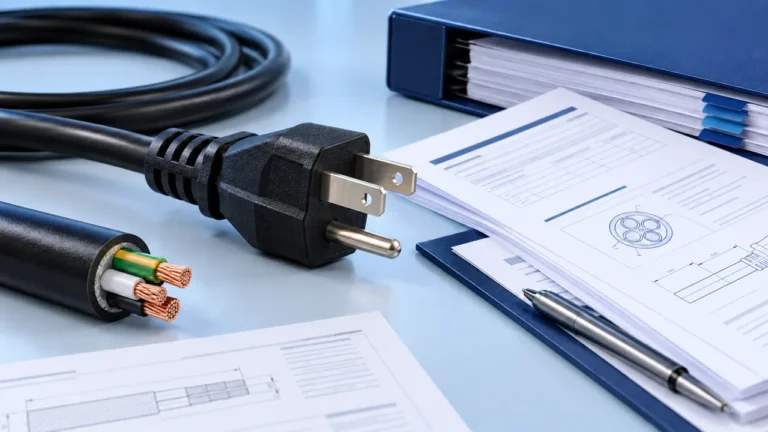
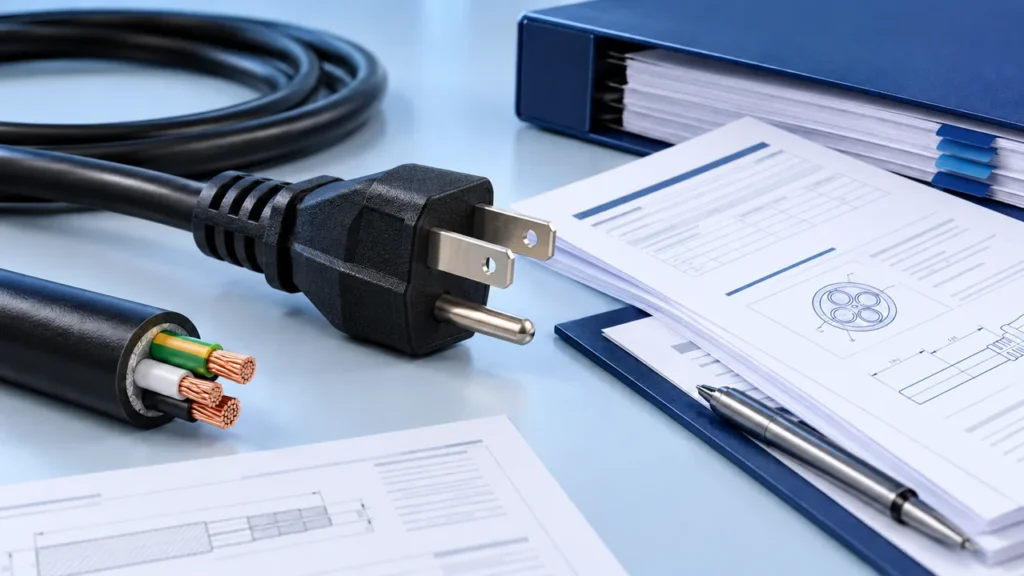
Power cord documentation should identify the destination market, equipment application and exact cord construction. Requirements depend on the product and market; a certificate for one component or factory does not establish conformity of every finished assembly.
Define the complete assembly
- Plug configuration, connector or termination and cord length.
- Voltage, current, conductor size and insulation or jacket construction.
- Temperature, environment, markings and strain-relief requirements.
- Destination market and equipment customer requirements.
Read power cord documentation at three levels
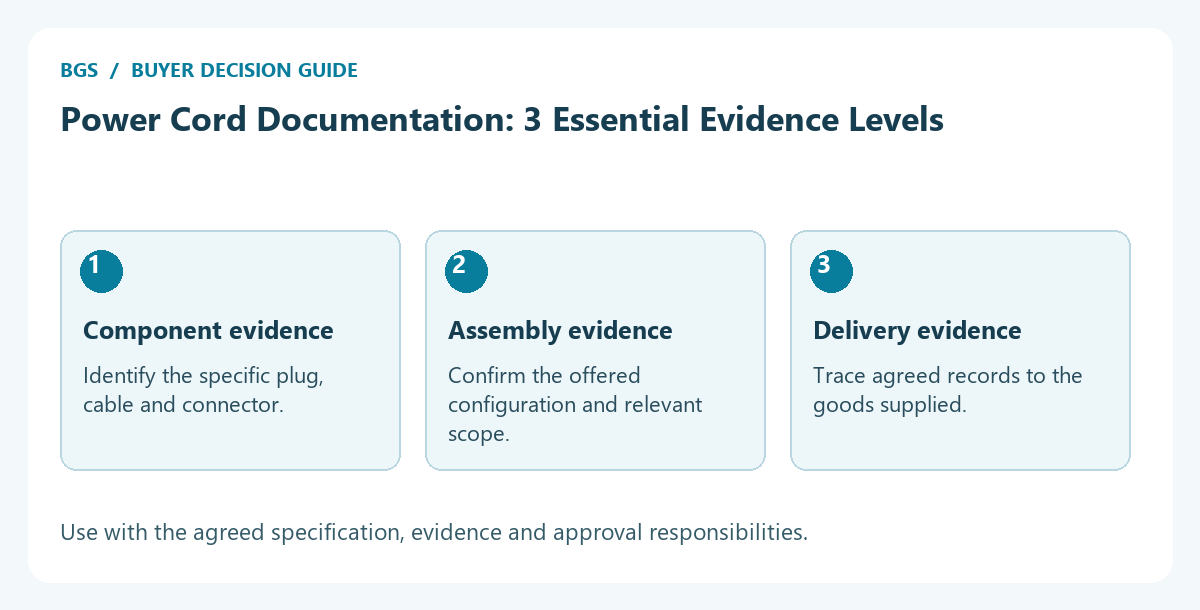
A file can be genuine and still fail to answer the buyer’s question. Match each document to the component, assembly or delivered batch it actually describes. Do not treat evidence for one component as automatic approval of every finished cord configuration.
| Evidence level | What it should identify | Common gap to resolve |
|---|---|---|
| Component | Specific plug, cable or connector and relevant approval scope | A logo or generic certificate without a matching reference |
| Complete assembly | Manufacturer, configuration, ratings and applicable conformity evidence | Components listed but the offered assembly remains undefined |
| Delivered batch | Order reference, approved revision, markings and agreed test records | Records cannot be traced to the goods received |
If the manufacturer changes a plug, cable source or connector, ask whether the approved configuration and supporting evidence remain applicable before accepting repeat supply. The data center power cord checklist covers equipment and connection details; this guide focuses on the evidence supporting the assembly. Keep the power cord documentation register with the accepted assembly reference for repeat orders. Send the assembly reference, required destination and available documents for a gap review.
Power cord documentation example: scope gaps
Suppose a supplier provides an approval record for the cable but the offer also includes a plug and connector. File the cable record under component evidence. Keep the finished assembly definition and any required assembly-level evidence as separate actions. Before dispatch, check that the delivery references the accepted configuration. If a component source changes, review the effect on the evidence before accepting the repeat order. This prevents a genuine document being used to support a broader claim than it covers.
Should buyers request a generic CE certificate for every cord?
Determine the applicable requirements for the actual product and destination. Where CE marking applies, review the relevant conformity documentation. A generic certificate request does not establish that the offered assembly meets those requirements.
Download the cable evidence register (CSV). Replace the prompts with your agreed requirements and keep the completed file with the order record.
Verify the approval reference and scope
Ask the proposed manufacturer to identify the standards and approval route relevant to the actual assembly. Check the manufacturer, factory, model, construction, rating and validity against the available evidence.
UL 817 covers cord sets and power-supply cords within its stated scope. Where UL certification is specified, verify the proposed product in the relevant certification record rather than relying on a logo. See UL Product iQ guidance and the UL 817 scope.
Distinguish CE marking from third-party certification
Where applicable EU legislation requires CE marking, the manufacturer is responsible for the conformity assessment, technical documentation and EU declaration of conformity. CE marking does not mean EU-authority product approval. Check the applicable product legislation and the evidence for your assembly; do not request a generic “CE certificate” as a substitute. See the European Commission’s CE marking guidance.
Request the required documents in the RFQ
- Assembly and component approval references where applicable.
- Controlled drawing and construction details.
- Electrical and mechanical test requirements and records.
- Material declarations requested for the intended market.
- Sample approval, marking and traceability requirements.
Control changes before production
Define how changes to conductor, compound, plug, connector or factory are reviewed. A previously accepted report may not cover a changed construction. Confirm the final evidence and responsibilities with the selected manufacturer and the buyer’s technical team before ordering.
For India or other destination markets, confirm the current applicable requirements for the actual product with the responsible manufacturer and relevant authority. This checklist helps organise the enquiry; it is not a market-access approval.
Prepare a power-cord RFQ before requesting approval evidence
Record both termination references, equipment or application, cable construction, length, quantity and destination. Ask the selected manufacturer to state the exact assembly offered and any exceptions. Keep the cable, plug and connector references together so the evidence review concerns the complete requested item.
IEC 60320-1 describes general requirements for appliance couplers within its scope. It does not establish compliance of a particular offered assembly. Confirm applicable requirements and destination evidence for the actual product. For a new requirement use the Power Cords & Assemblies page and request the existing fillable RFQ checklist.
Reference for the component-scope review
IEC 60320-1: publication scope. Product-specific technical approval is required before treating an alternative assembly as equivalent.