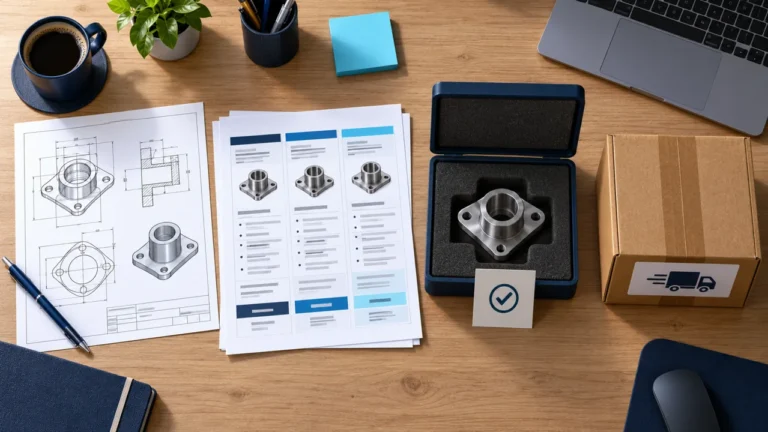

Quality control when sourcing from India starts with the product requirement and the agreed purchase route. Define the checks, responsibilities and records before committing to production.
Review the manufacturing source
Assess the proposed process, relevant equipment, comparable work and available capacity against your component. Clarify which operations are performed in-house and which are subcontracted. Management-system certificates should be checked for scope and validity; they do not establish that a particular product meets your drawing.
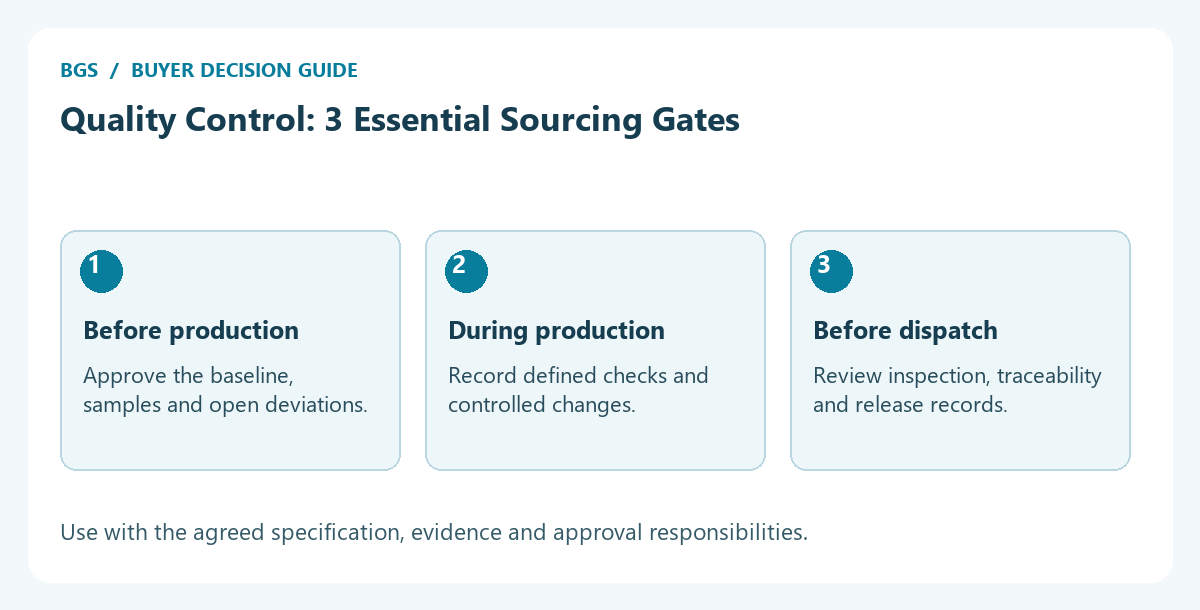
Put the quality control plan on one page
Agree the plan before sampling or booking an inspection visit. Each check needs a requirement, a method, a record and an owner. A late instruction to “check quality” cannot replace an agreed acceptance basis.
| Stage | Record to agree | Decision owner |
|---|---|---|
| Before production | Approved revision, material requirements, sample results and deviations | Buyer’s authorised engineering or quality representative |
| During production | Defined in-process checks and change notifications | Manufacturer, with agreed buyer review points |
| Before dispatch | Inspection results, open nonconformances, packing and traceability records | Named person authorised to release the shipment |
Where BGS inspects every unit on orders placed on BGS, the agreed criteria still define what that inspection covers. It does not mean every possible test, including destructive testing, is performed on every unit. Record any sampling-based tests separately. For machined parts, use the CNC drawing and inspection checklist to define feature-level records. Share the product requirement and proposed acceptance criteria to agree the inspection scope.
Quality control example: a changed finishing source
Suppose the first sample is accepted, but the factory later proposes a different finishing subcontractor. Ask whether the change affects the approved process and what verification is needed. The quality plan should identify who reviews that change, which evidence is required and whether production must pause. At dispatch, check the actual agreed records and outstanding deviations. Sample approval remains useful only when later production follows the approved basis or a documented change.
Does every-unit inspection mean every possible test is performed?
No. The agreed criteria define the checks applied to each unit. Other checks may use sampling or require destructive testing. Specify the method, frequency, records and acceptance responsibility for each requirement.
Download the manufacturing inspection plan (CSV). Replace the prompts with your agreed requirements and keep the completed file with the order record.
Set sample acceptance criteria
Agree the drawing revision, material, critical characteristics and tests before samples are made. Record the sample results, deviations and approval decision. If prototypes use a different process, identify what they demonstrate and what still needs production validation.
Review our supplier development and quality coordination scope when defining responsibilities for qualification, samples and inspection.
Agree production review points
Define who reports material readiness, tooling progress, sample status and production milestones. State which changes require written approval. In-process visits, testing and reporting should be included only where they form part of the agreed scope.
Define inspection and release
Agree inspection methods, acceptance criteria, quantities checked, required records and release responsibilities. On orders placed on BGS, every unit is inspected against the agreed criteria. For a direct manufacturer order, BGS inspection and coordination services are agreed separately.
Prepare the document list
- Controlled specification and approved deviations.
- Sample or trial records where applicable.
- Inspection and test records included in the order.
- Material or product declarations required for the application.
- Packing and dispatch documents.
The document package depends on the product, destination market and written order scope. Request it at RFQ stage so the supplier can price and plan the work.
Separate quality records from export paperwork
Make a document schedule before placing the order. One part should identify product and quality evidence, such as the agreed inspection record and source-specific test documents. Another should identify shipment records and the party responsible for preparing each one. Link both to the product definition and order reference.
DGFT’s export guidance identifies transport documentation, a commercial invoice with packing details, and customs shipment documentation among the core records. Additional requirements depend on the goods and destination. Ask the responsible exporter or customs professional to confirm the current shipment-specific requirements rather than treating a generic checklist as a complete clearance pack.
Export-document reference
DGFT: How to Export guidance. Review the supply coordination scope and agree document responsibilities before dispatch.