Custom cable lead times need to reflect the stages, dependencies and approval points for the actual construction. A general lead-time estimate becomes useful only when its start conditions and completion milestones are clear.
Prepare the quotation inputs
For construction options, review our wire and cable sourcing scope. Provide the conductor construction, insulation and jacket materials, ratings, dimensions, marking, packing, initial quantity and expected demand. State the destination country, required documents and target date. Missing inputs can prevent a comparable quotation or a reliable schedule.
Plan custom cable lead times around release conditions
Ask the supplier what starts each quoted duration. “Production lead time” may begin only after drawing approval, material receipt and order release. Record those conditions beside the date so an apparently short quotation does not conceal a long period before production can start.
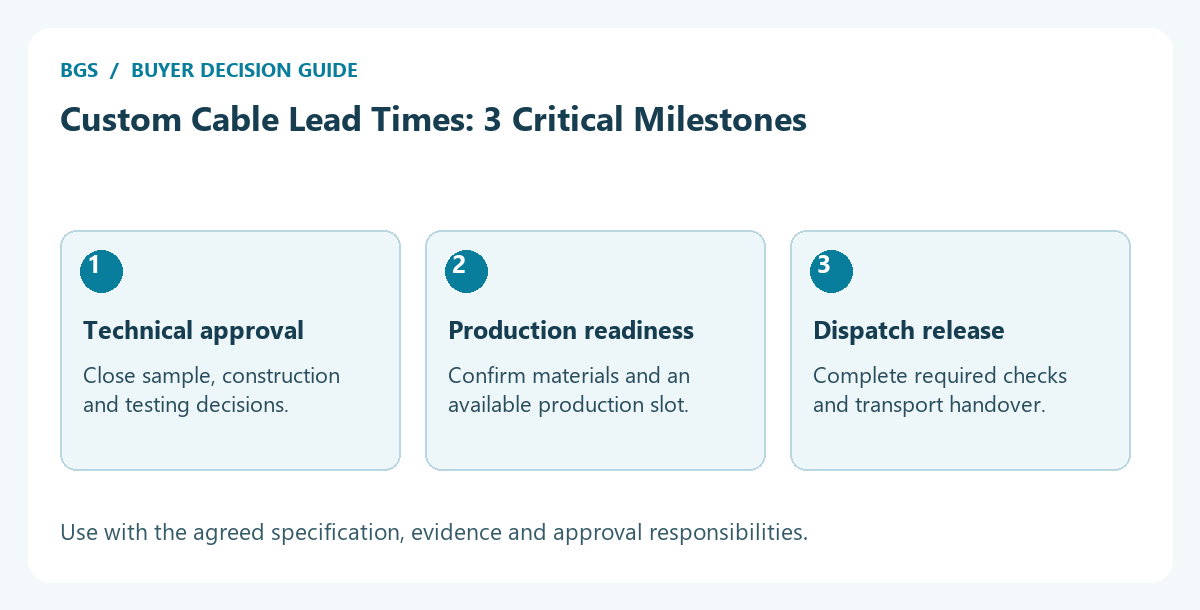
| Milestone | Start condition | Completion evidence |
|---|---|---|
| Technical and sample approval | Agreed construction, test scope and representative sample route | Written disposition of results and deviations |
| Material and production readiness | Required inputs available and suitable production slot confirmed | Material status and dated production plan |
| Dispatch readiness | Manufacture, required testing and inspection completed | Release record, packing details and transport handover plan |
Some activities can overlap; others depend on an earlier approval. Have the manufacturer identify the dependencies and any agreed contingency instead of adding an arbitrary number of weeks. Separate ex-factory readiness, carrier handover and arrival. When timing depends on a new factory, qualify its available cable capacity before treating a schedule as a commitment. Share the specification, volume and required arrival date for a milestone review.
Custom cable lead times: compare the same starting point
Suppose two suppliers both quote the same production duration. One starts its clock after sample approval; the other starts only after approval and receipt of a special compound. Ask each to put its start conditions beside the promised date. Track sample review, compound readiness and the production slot separately. Add a responsible owner to every open dependency. The resulting plan shows which action can move the delivery date and avoids mistaking a manufacturing duration for an arrival commitment.
Should transport time be included in production lead time?
Keep the milestones explicit. State when goods are expected to be ready at the factory, when carrier handover is planned and which arrival date is being estimated. Identify the party responsible for each stage.
Download the cable milestone planner (CSV). Replace the prompts with your agreed requirements and keep the completed file with the order record.
Where UL certification is specified, use UL’s certification database guidance to plan record verification before closing that qualification milestone.
Allow for samples and approval
Confirm whether existing samples are representative or whether a development run is required. Agree the sample quantity, evaluation criteria, freight arrangements and approval responsibility. Keep time for resolving deviations before production release.
Confirm tooling and material readiness
Ask whether new tooling, special compounds or non-standard conductor stock is needed. Identify procurement dependencies and any test or approval requirements. Parallel work should begin only where responsibilities, costs and risks are agreed.
Agree the production window
The manufacturing schedule depends on quantity, construction complexity, changeovers and available capacity. Ask the manufacturer to confirm the start condition, planned completion and what happens if a key input or approval is delayed.
Include inspection, packing and transport
Allow for the agreed tests, inspection, corrective action where needed, packing, export documents and freight booking. Distinguish factory readiness, dispatch and arrival at the destination. State the delivery basis and responsibilities in the quotation and order.
Use a milestone checklist
- Technical inputs complete and open points resolved.
- Quotation scope and commercial terms agreed.
- Materials and tooling available.
- Samples approved where required.
- Production and agreed checks completed.
- Dispatch documents and freight arrangements ready.
Use the power cord and cable RFQ checklist to organise the technical inputs. Share your target date with BGS when enquiring. The proposed schedule should be reviewed with the selected manufacturer and confirmed for the agreed scope; no fixed duration is promised by this guide.