Your regular cable supplier has moved the delivery date again. Assembly is still scheduled, the equipment specification has not changed, and purchasing needs another source. A second quotation is easy to obtain. A second factory that can supply approved cable in time is a different matter.
Finding alternative cable manufacturers in India should therefore start with one question: which source can deliver this construction, in these lengths, within the required window—and keep supplying it? The answer needs evidence from production, engineering and quality, alongside a workable commercial agreement.
This guide follows that decision through seven checks. The aim is to establish how much volume you can safely release to another manufacturer during a supply constraint, without discovering an approval gap or a production bottleneck after placing the order.
Before releasing an alternate-source order, confirm five things: the factory can repeat the required construction; its documents cover the relevant product and source; samples and any required pilot meet agreed acceptance criteria; a usable production window is reserved; and the buyer has authorised the quantity being released. Keep unresolved points visible, with an owner and a due date.
1. Verify capacity at alternative cable manufacturers in India
A manufacturer’s installed capacity is not the same as capacity available for your order. When assessing cable manufacturing capacity in India, annual tonnage combines different products, conductor sizes, production rates and working patterns. It cannot tell an OEM whether a particular screened, flexible or elastomer-insulated cable has a realistic production slot next month.
Ask the proposed factory to walk through the route for your construction: conductor preparation, insulation, curing where required, laying-up, screening, sheathing, testing and rewinding. Identify the operation that limits finished output. Then check its existing commitments.
A sheathing line may have spare hours while the braiding operation is fully booked. A factory may also rely on another business for a specialist process. In both cases, available machine time at one stage overstates the capacity you can use.
- Look for comparable production records. Review recent acceptable output, changeovers, losses and downtime for similar constructions. Redacted records or a witnessed review can protect other customers’ information.
- Separate total output from uncommitted output. Confirm the quantity available after existing orders, maintenance and planned changeovers.
- Check the supporting resources. Specified compounds, conductor stock, operators and test equipment must be available for the same window.
- Put the proposed allocation in writing. Record the quantity, production period, start conditions and the point at which the slot becomes reserved.
When comparing alternative cable manufacturers in India, ask for the same unit of commitment. “Twenty kilometres a month” is not comparable with “one production run after material receipt” until the construction, usable lengths and timing are defined.
A simple capacity check
Use the limiting operation as the starting point. For illustration, 80 uncommitted hours at a demonstrated 150 metres per hour, with 95% acceptable output, give 11,400 metres. That falls short of a 12 km release before any further length or packing constraint.
These are hypothetical figures, not a factory estimate. Use the supplier’s actual records and agree the assumptions. Do not deduct downtime twice if the demonstrated rate already includes it. Finally, confirm that the hours are reserved: an available slot can disappear while an OEM is still approving samples.
Keep the verification proportionate to the order. For a standard construction on an established line, a focused production review may resolve the question. A new compound, outsourced operation or unfamiliar cable design calls for a closer look. Agree access and confidentiality before requesting records, and record who checked the evidence and when.
2. Match the approval evidence to the offered cable
Start with the controlled equipment specification and destination market. The responsible engineer should identify the applicable product standard, edition, amendments, customer approvals and required test evidence. Avoid assuming that a familiar standard number settles the whole requirement.
For each candidate, establish three separate facts: the factory can make the construction; the proposed cable meets the required performance; and any mandatory or customer-required certification covers the actual source and product. A factory quality-system certificate does not establish product approval.
Match the evidence to the manufacturer’s legal name, manufacturing location, cable designation, ratings, size range and proposed materials. If a report covers a related construction, ask the technical reviewer to explain what it supports and what still needs testing. Keep that decision with the approval record.
For claimed UL certification, check the certification record and relevant markings. UL Solutions identifies Product iQ as a route for verifying wire and cable certification information. For a claimed BIS licence, use the BIS licence-verification resources and review the scope. These checks establish the evidence for a particular offer; they do not make every product from that factory suitable.
If the cable forms part of approved equipment, determine whether a source or material change needs customer or certification-body review before use. This can affect the first usable delivery date even when the factory has spare capacity. For that specific cable family, our IS 9968 procurement guide covers the documentation review in more detail.
Keep the evidence status explicit: “supplier-stated” records a claim; “document received” means the record is available; “tested” applies only to the identified sample and test scope; and “buyer approved” requires the responsible buyer’s acceptance. Do not use these labels interchangeably in the comparison or delivery plan.
3. Check process fit during OEM cable supplier qualification
OEM cable supplier qualification needs more than a capability list. Review how the proposed factory will control the features that matter to your equipment. Experience with fixed-installation cable, for example, is not by itself evidence of continuous-flex performance.
Discuss conductor stranding, extrusion control, insulation thickness and eccentricity, curing where applicable, screen construction and sheath application. Ask which parameters are recorded, where measurements are taken and how a process deviation is linked to the affected batch or length.
Identify bought-in conductors, compounds and outsourced operations. Confirm who approves these sources and how a proposed substitution reaches the OEM. Establish which changes need written approval after qualification, including changes to material, manufacturing location or the agreed process route.
Resolve the development gap commercially. A source may be technically promising but need tooling, a compound trial or an outside test. Price those activities, name the owner and agree what happens if the trial fails. “We can make it” should lead to a defined development plan, rather than an immediate commitment for the full annual volume.
This is where alternative cable manufacturers in India often become distinguishable: one can repeat the construction on an established route, while another is quoting a development project. Both may deserve consideration, but they present different cost and timing risks.
A qualification lesson from BGS sourcing work
During a rubber-cable source evaluation coordinated by BGS, an available sample differed from the buyer’s requested production construction. It offered a starting point for reviewing appearance and workmanship, but could not establish approval of the required cable.
The discussions also exposed a dimensional-control question. The buyer required achievable outer-diameter tolerances to be confirmed for the actual cable constructions, rather than accepting a broad tolerance across the range. BGS requested updated technical datasheets and written capability confirmation before progressing the evaluation.
The lesson is practical: an available sample and a general manufacturing claim do not establish a qualified alternate source. Confirm what the sample represents, close construction-specific deviations and keep the buyer’s approval conditions explicit. This example describes an evaluation stage; it does not claim completed supplier approval or recurring production supply.
An approval record for OEM cable supplier qualification
Use one record to connect the technical decision with the commercial release. Keep supporting reports and source documents attached to it so the next reviewer can see what was accepted.
| Decision | Evidence to close | Permitted commitment | Approval responsibility |
|---|---|---|---|
| Develop the source | Proposed construction, process route, approval scope and development gaps. | Defined sample or development work, with agreed cost and ownership. | Engineering reviews feasibility; purchasing authorises the defined spend. |
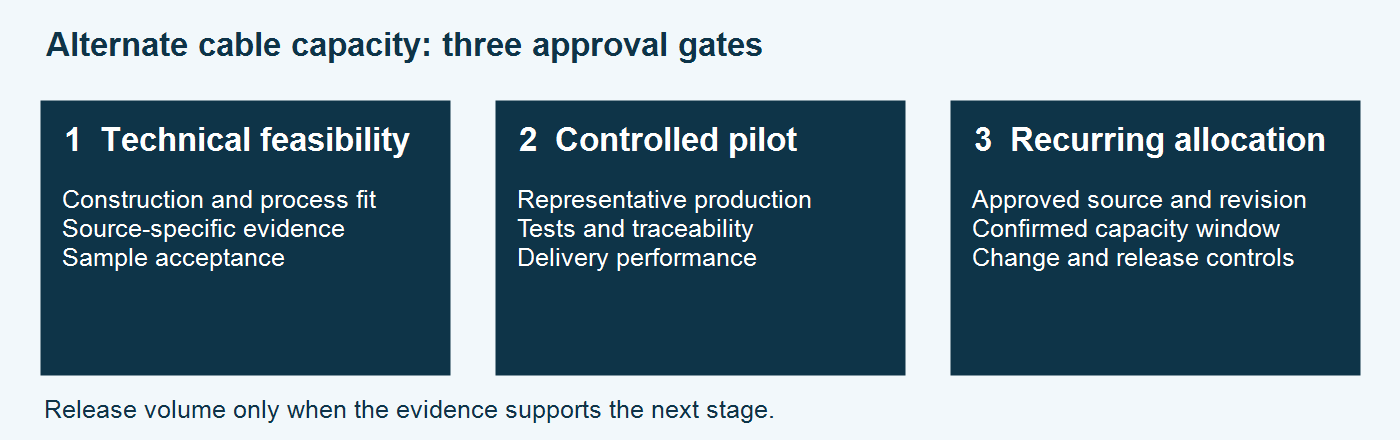
| Run a pilot | Accepted samples, production route, test plan and release criteria. | A controlled quantity with explicit acceptance conditions. | Engineering and quality close acceptance criteria; purchasing issues the controlled release. |
| Allocate recurring volume | Accepted pilot, confirmed capacity, replenishment terms and change control. | Firm releases within the approved supply arrangement. | Quality and engineering confirm the approved scope; purchasing confirms allocation and terms. |
The roles above are a suggested working arrangement; use the OEM’s actual approval matrix. Name the individuals who can approve a technical change, accept test evidence and authorise shipment. A sourcing coordinator can obtain records and follow up actions, but should not be assumed to hold the buyer’s approval authority.
4. Use samples to answer a defined approval question
Before ordering samples, agree what the evaluation must establish. Record the cable revision, manufacturing route, sample quantity, required records, test methods, acceptance limits and the person authorised to approve the result. Identify any difference between the sample and intended production process.
Select checks against the specification and application. Depending on the requirement, these may include conductor resistance, dimensions, insulation resistance, voltage withstand, mechanical properties, ageing, and relevant environmental or fire-performance tests. Movement, screening or other functional requirements need their own evidence. The technical reviewer should decide what applies and whether an external laboratory is needed.
Keep routine production tests separate from qualification or type tests. Passing basic electrical checks on a short sample does not demonstrate every service condition. Equally, a report for one material or cable design does not automatically establish the behaviour of a proposed substitute.
After sample acceptance, run a controlled pilot through the proposed production route. Review the supplied cable, test records, yield, traceability, packing and delivery performance. Close deviations before increasing the allocation. The pilot’s purpose is to establish repeatability under production conditions, not merely to obtain a longer sample.
Sample acceptance closes the agreed technical questions. Purchasing must still confirm the production slot, material availability and recurring quantity before releasing volume.
Three stages of OEM cable supplier qualification
- Appearance reference: useful only for the agreed preliminary observations. Record differences from the required cable.
- Specification sample: made to the proposed cable revision for the defined technical evaluation. Identify the manufacturing route and required test records.
- Production pilot: a controlled run through the intended production route, used to check repeatability, traceability and release performance.
5. Make inspection part of shipment release
Agree an inspection and test plan before production starts. It should identify the checks, acceptance criteria, inspection stage, responsible party and required records. Add witness or hold points where needed, along with clear authority to release or stop shipment.
Traceability should connect the supplied drums to the approved construction, material records and production tests. Confirm drum identification, usable lengths, cable markings, packing and the document pack. Agree sampling rules and any tests required on every length or batch.
Set the response to a failed result in advance. Who contains the affected material? Who reviews rework and retesting? Who can approve a concession? A late delivery creates pressure, but it should not become the reason an unapproved deviation reaches equipment assembly.
Visual inspection cannot establish all electrical, material or endurance properties. Specify the necessary tests separately. BGS inspection and coordination responsibilities follow the agreed order scope; the manufacturer, buyer and any independent inspector need a common understanding of those responsibilities.
6. Plan industrial cable sourcing from India around the first delivery
For industrial cable sourcing from India, distinguish the first qualified delivery from a repeat-order lead time. The first order may include engineering review, approval verification, material procurement, tooling, samples, laboratory work and corrective action before production can be released.
Work backwards from the equipment programme’s required arrival date. Identify the dependency, owner and completion evidence for each stage. Confirm whether the quoted date means factory readiness, dispatch or destination arrival. Our custom cable lead-time guide explains the underlying schedule stages.
Some work can run in parallel, but the exposure must be explicit. If material is bought before sample acceptance, agree who bears the cost if the specification changes. If a production slot expires during testing, establish when the next slot can be confirmed. Build in time for inspection, corrective action, export preparation and transport.
For recurring supply, agree forecast visibility, firm releases, minimum production batches, call-off windows and any reservation charge. Clarify price validity, metal-price adjustment, payment terms, tooling ownership and cancellation exposure. Compare the landed supply cost and qualification expenditure, rather than the cable price alone.
Small, irregular orders can make an alternate route expensive to maintain. Discuss whether a limited recurring allocation or an agreed material buffer would keep it practical. Identify ownership, storage conditions and review dates for any buffer. There is no universal stock level or allocation percentage: use the OEM’s demand and disruption assumptions.
7. Release only the volume supported by the evidence
Record the approved factory, cable revision, production route and permitted release quantity. List every open condition with an owner and due date. The approval should tell purchasing exactly what it can order now.
Use a phased transition when the timing or repeatability is still uncertain. Define what would trigger a hold or reduced allocation, such as failed tests, an unapproved material change, missed milestones or loss of the reserved slot. Confirm an escalation route with people who can make production and release decisions.
Also test whether the second source reduces the original disruption risk. Two factories may share a specialist compound supplier, subcontractor or outside laboratory. Qualifying alternative cable manufacturers in India adds less resilience if both routes stop for the same reason.
After the first shipments, review on-time factory readiness, first-pass acceptance and closure of corrective actions. Reassess the approval after a long supply gap or a significant change to the source or equipment requirement.
A documented release decision keeps OEM cable supplier qualification tied to the cable, factory and quantity actually reviewed. Increase allocation against the supplier’s delivery and conformance record.
Questions about alternative cable manufacturers in India
Can an existing approval be transferred to another factory?
Do not assume that it can. Review the relevant customer or certification requirements and obtain a decision from the responsible party. The construction may be familiar while the manufacturing source is outside the documented scope.
Should we pay to reserve capacity before qualification finishes?
Compare the timing benefit with the financial exposure. Define the reserved window, expiry date, release conditions and treatment of failure or delay. Keep reservation charges separate from non-recoverable material or development expenditure. The order should reflect the actual agreement.
What if a different compound would shorten the lead time?
Ask engineering to review the complete proposed change, including performance, processing, test evidence and approval scope. Record the accepted revision and any further validation. A faster material supply is useful only if the resulting cable remains suitable for the equipment and destination market.
Can the full annual volume move after one successful pilot?
Only if the evidence and supply agreement support that decision. A pilot establishes the conditions demonstrated during the run. Confirm recurring capacity and replenishment terms, then review the first production releases before increasing allocation.
Ask BGS to review the alternate-source route
Bhuvika Global Solutions is a sourcing and coordination company working with manufacturing partners. We can coordinate a requirement-specific review of candidate sources, technical and commercial inputs, samples and agreed inspection. Capability, approvals, capacity and lead time are confirmed for the selected manufacturer.
Explore our industrial wire and cable sourcing scope for relevant cable families. For an alternate-source review, include the required first-delivery date and any approvals tied to your current cable, alongside the specification and demand.