An EPR vs silicone cable insulation comparison starts with the application. Ask manufacturers to propose a complete construction against the same service conditions, then compare declared limits and evidence. A material label alone does not establish the rating or suitability of the finished cable.
Separate insulation from the complete cable
EPR means ethylene propylene rubber. Silicone is another insulation family. The conductor, insulation, sheath, reinforcement and terminations all belong in the review. Eland’s BS 6195 guidance illustrates why the construction matters: it describes EPR-insulated Type 4 and silicone-insulated Type 5 cable variants. Those descriptions are specific to that cable range, not universal ratings for every EPR or silicone product.
EPR vs silicone: decide on the complete cable
A higher published temperature limit does not settle the purchasing decision. The proposed cable still needs to meet the mechanical duty, termination arrangement and applicable requirements. Compare named constructions rather than accepting “silicone equivalent” or “EPR equivalent” without supporting data.
| Buyer question | Useful evidence | Decision to record |
|---|---|---|
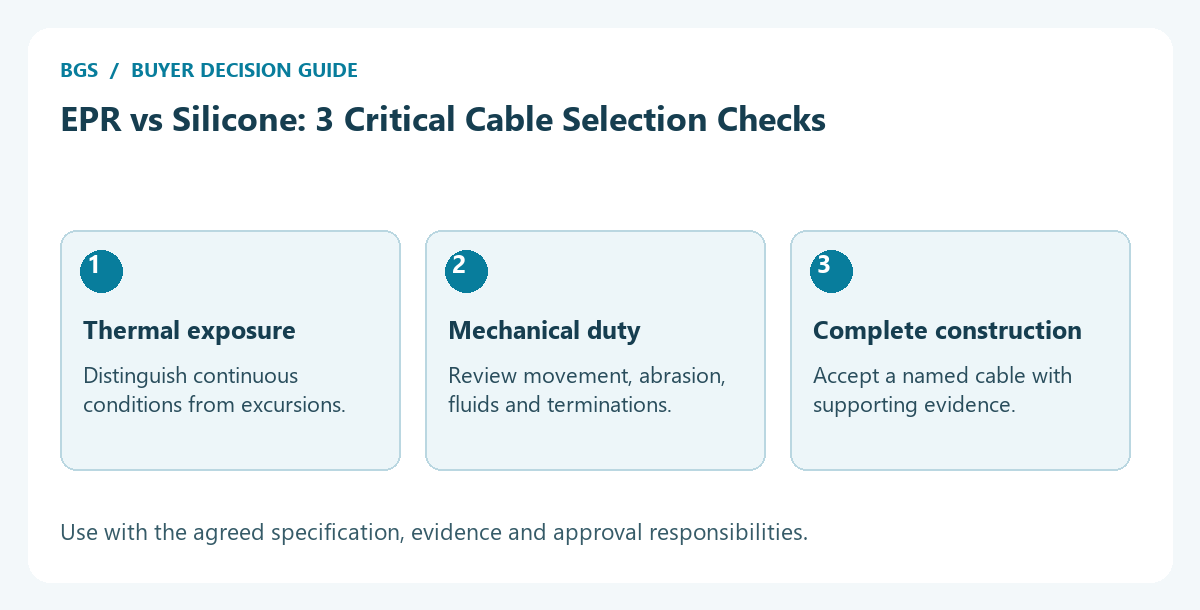
| What temperature exposure must the cable withstand? | Application conditions and the offered construction’s datasheet | Accepted operating conditions and unresolved limits |
| Will the cable move or face abrasion, fluids or repeated bending? | Application-specific suitability information and agreed testing | Whether the complete construction suits the duty |
| Does the alternative change manufacturing source or approval scope? | Manufacturer identity, relevant records and representative sample | Required requalification before production release |
Illustrative example: replacing a cable solely because another insulation has a higher headline heat rating may leave its mechanical suitability unresolved. Ask engineering to close both questions. If the material change also requires a new factory, follow the alternate cable manufacturer qualification process. Submit the existing cable specification, application conditions and destination for review.
EPR vs silicone example: separate heat and wear
Suppose a buyer asks for a higher-temperature alternative to an existing EPR-insulated cable. The silicone offer declares a suitable thermal limit, but its proposed construction has not been reviewed for the installation’s mechanical duty. Keep those two questions separate. Ask for the actual datasheet and application-specific evidence, then agree any required testing. A thermal advantage does not close an unanswered question about abrasion, repeated movement or the termination arrangement.
Can EPR be replaced by silicone without another review?
Treat the change as a proposed substitution. Compare the complete constructions, service conditions, applicable requirements and supporting records. The insulation name or a higher temperature figure alone does not establish equivalence.
Download the cable evidence register (CSV). Replace the prompts with your agreed requirements and keep the completed file with the order record.
Give both suppliers the same conditions
- Continuous and occasional temperature exposure, with duration and location.
- Electrical requirement and the standard or customer specification to be met.
- Fixed installation, repeated movement, handling and bending expectations.
- Contact with oil, water, cleaning agents, abrasion or outdoor conditions.
- Termination arrangement, assembly method and inspection evidence required.
Compare the cited cable constructions
The following example concerns the BS 6195 constructions described by Eland Cables. It shows why a cable type and supporting datasheet matter; it is not a temperature rating for every EPR or silicone cable.
Scroll sideways to compare both cable types.
| Review point | EPR example | Silicone example |
|---|---|---|
| Construction identified | BS 6195 Type 4 cable with EPR insulation. | BS 6195 Type 5 cable with silicone-rubber insulation. |
| Published maximum conductor operating temperature | 90°C for the cited Type 4 construction. | 180°C for the cited Type 5 construction. |
| What a buyer must confirm | Exact type, voltage, conductor, insulation, sheath and applicable test evidence. | Exact type, voltage, conductor, insulation, sheath and applicable test evidence. |
| Substitution decision | The responsible engineer must review the complete proposed cable against the intended duty. These example temperatures do not establish suitability, interchangeability or BGS supplier capability. | |
Source: Eland Cables BS 6195 Type 4 and Type 5 guidance. Request current construction-specific evidence from the actual proposed manufacturer.
Use an offer-comparison worksheet
Record each declared property next to the supporting datasheet or test reference. Mark missing information as unresolved. If a supplier proposes a substitute construction, ask what changed and why the original requirement can still be met. Keep the engineering decision with the drawing or specification revision.
Avoid a single-number decision
A headline temperature number should not replace the full application review. Request the conditions, test method and limits behind a declaration. Ask whether the limit applies to insulation, conductor, sheath or the assembled product. Check compatibility with the intended connector and equipment documentation through the responsible engineer.
Questions for sample approval
- Does the sample match the proposed production construction?
- Which checks demonstrate the specified behaviour?
- Are identification and traceability requirements clear?
- What evidence is needed if the compound or source changes?
Prepare a sourcing enquiry
Use the cable sourcing page to discuss the construction. BGS reviews requirements through selected manufacturers. No particular compound, temperature rating or approval is promised without source-specific review.
Sources and scope
Sources checked on 18 October 2026. This buyer checklist helps prepare an enquiry. The actual construction, acceptance criteria and applicable requirements need review for the intended application. It does not certify a product or a manufacturer.